

Blood Clots After Long Flights: DVT Risks & Prevention in Bedford, TX
After a long flight, you’re probably eager to stand up, grab your luggage, and head home. But have you thought about what sitting in one position for hours can mean for your circulation? Blood clots after long flights are uncommon, but they’re worth understanding, especially if you travel often or have certain health conditions. At Preferred Primary Care, a trusted primary care clinic in Bedford, TX, we want you to travel with knowledge instead of worry. Here’s what deep vein thrombosis (DVT) is, who is at higher risk, and how to lower that risk.
If you travel for work, you may land and go straight back to meetings. If you’re a parent, you may head directly into carpools and laundry. Neither role automatically raises your DVT risk. But when schedules are packed, building in movement and noticing changes in your body is easy to overlook.
The same goes if you’re traveling with children or older family members. It helps to know what to watch for in everyone. Our Corporate & Professional Primary Care services support busy adults with preventive healthcare and early evaluation that fits real schedules.
Understanding Blood Clots After Long Flights
When you sit still for hours, your calf muscles stop squeezing the veins that carry blood back to your heart. Blood moves more slowly, and in some people it can begin to clot inside a deep vein.
The risk depends on trip length. For flights under four hours, the risk of a symptomatic clot is negligible [2]. Does every long flight cause a clot? Not at all. Long-distance air travel may raise clot risk two- to four-fold, but the absolute risk is small. One large study estimated about one event per 4,656 flights longer than four hours. For healthy travelers, risk is generally low, but it can rise when other risk factors are present.
What Is Deep Vein Thrombosis (DVT)?
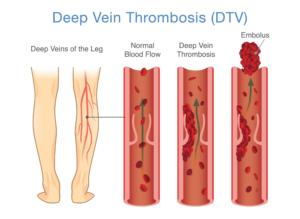
DVT is a blood clot in a deep vein, most often in the leg, thigh, or pelvis. It differs from a superficial vein problem, which affects veins near the skin and is usually less serious. Deep clots can break loose.
If a piece travels to the lungs, it can block blood flow. This is called a pulmonary embolism (PE), and it can be life-threatening. The CDC estimates that up to 900,000 people in the U.S. are affected by DVT or PE each year.
Who Is at Higher Risk of Blood Clots After Long Flights?
Most travel-related clots happen in people who already have at least one risk factor. Studies suggest 75–99% of affected travelers did. Risk is individual, and having a risk factor doesn’t mean you’ll develop a clot. Higher risk is linked to:
- A previous DVT or PE
- Recent surgery or injury
- Limited mobility
- Pregnancy and the postpartum period
- Estrogen-containing medications
- Certain cancers and cancer treatments
- Obesity
- Older age
- Inherited or acquired clotting disorders
Having several of these together raises risk more than any one alone.
DVT Symptoms After Flying: Warning Signs to Recognize
Symptoms can appear during your trip or after you’re home. Most travel-related clots occur within the first one to two weeks after a flight, and risk returns to baseline by about eight weeks [2]. You may notice:
- Swelling in one leg
- Leg pain or tenderness
- Warmth in the affected area
- Redness or skin discoloration
- Unexplained leg discomfort
DVT can also cause no symptoms. About half of people with DVT have none, so don’t rely on feeling fine.
Emergency warning signs of pulmonary embolism:
- Sudden shortness of breath
- Chest pain, especially when breathing deeply or coughing
- Coughing up blood
- Fainting or severe lightheadedness
These symptoms need immediate emergency care. In the United States, call 911.
How Is DVT Diagnosed and Treated?
A clinician will start with your medical history, a physical exam, and a review of your personal risk factors. A healthcare consultation in Bedford, Texas is a good place to talk through that individual risk. Depending on the situation, evaluation may include:
- D-dimer blood testing, when appropriate
- Compression ultrasound
- Other imaging when clinically indicated
Treatment may involve prescription anticoagulant medication and other interventions, depending on the patient’s condition. These decisions are always individualized and should be guided by a healthcare professional.
How to Prevent Blood Clots During Long Flights
Prevention is mostly about keeping your blood moving, and a few simple habits help. Consider:
- Walking periodically when it’s safe and permitted
- Doing ankle circles and calf exercises while seated
- Avoiding long stretches without movement
- Choosing an aisle seat when practical, so moving is easier
- Asking a healthcare professional whether compression stockings make sense for you
- Seeking medical guidance before travel if you’ve had a clot or have other significant risk factors
Compression stockings aren’t necessary for every traveler. Staying comfortable and hydrated is good for any trip, but water alone has not been shown to prevent clots. Don’t take aspirin or blood thinners for travel unless a healthcare professional advises it. Higher-risk travelers may need an individualized prevention plan.
When Should You Speak With a Healthcare Professional?
If you’ve recently traveled and notice leg swelling, pain, warmth, or redness, schedule a prompt visit. Don’t wait for it to pass, and don’t try to diagnose it yourself. It’s also wise to talk with a clinician before a long trip if you have significant risk factors. You can learn more about our physicians.
A routine visit is appropriate for leg symptoms and pre-travel questions. Sudden breathing trouble, chest pain, coughing up blood, or fainting is an emergency. Call 911.
Blood clots after long flights are a real but manageable concern. A little awareness, regular movement, and the right medical guidance go a long way. At Preferred Primary Care, a patient-centered, community-focused clinic in Bedford, Texas, we believe in preventive healthcare and early evaluation. If you have travel plans, risk factors, or questions about leg symptoms, contact us to schedule an appointment. We’re here to help you travel and come home with confidence.
FAQs
Can you develop a blood clot after a long flight?
Yes, though it’s uncommon. Sitting still for four hours or more can slow blood flow in the legs. Most travelers never develop a clot, and most who do have at least one other risk factor. Knowing your risk helps you prepare.
How long after flying can DVT symptoms appear?
Symptoms can appear during the trip or after you return. Most travel-related clots occur within one to two weeks of a flight, and risk returns to baseline by around eight weeks. Leg symptoms that start at home still deserve attention.
What are the first signs of a blood clot in the leg?
Common early signs include swelling in one leg, pain or tenderness, warmth, and redness or discoloration. Some clots cause no symptoms [4]. If something seems off, a clinician can evaluate it. Please don’t self-diagnose.
How can you prevent blood clots during long flights?
Walk when it’s safe, do ankle circles and calf exercises in your seat, and avoid long periods without moving. An aisle seat can make this easier. If you have risk factors, ask a healthcare professional about an individualized plan.
When should you see a doctor for suspected DVT after traveling?
See a clinician promptly for leg swelling, pain, warmth, or redness after travel. Seek emergency care by calling 911 for sudden shortness of breath, chest pain, coughing up blood, or fainting, which can signal a pulmonary embolism.
Book an Urgent Consultation
Need immediate medical attention? Our team is ready to assist you quickly and efficiently. Schedule your urgent consultation now and get the care you need without delay.